Sequence Grid
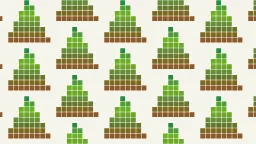
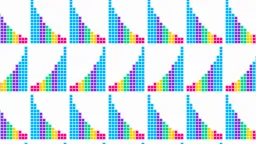
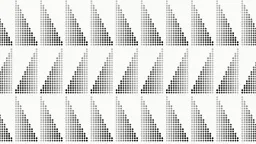
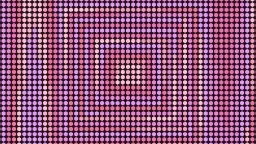
Each term of a sequence drawn as a row of blocks, set side by side so the sequence's growth becomes a staircase, scaled up into a background.
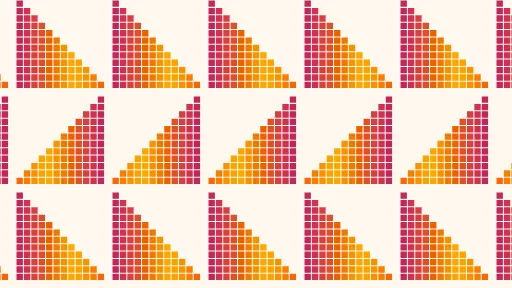
Draw each term of a sequence as a row of blocks and set the rows side by side, so the growth of the sequence becomes a staircase, enlarged into a background. The sequence rule decides how fast the steps climb.
How the maths works
- Arithmetic (common difference d)
- aₙ = a₁ + (n − 1) · d
- Geometric (common ratio r)
- aₙ = a₁ · rⁿ⁻¹
- Square numbers
- aₙ = n²
- Triangular numbers
- aₙ = n(n + 1) / 2
- Fibonacci
- Fₙ = Fₙ₋₁ + Fₙ₋₂
An arithmetic sequence adds the same common difference d each time, so its staircase climbs in even steps. A geometric sequence multiplies by the same common ratio r, so its steps grow faster and faster when r > 1 and shrink when r < 1.
Square numbers 1, 4, 9, 16 … and triangular numbers 1, 3, 6, 10 … are figurate numbers: each counts the dots in a square or triangle one size larger. Their differences grow by 2 and by 1, so their staircases bend upward like a parabola.
In the Fibonacci sequence each term is the sum of the two before it. The ratio of neighboring terms approaches the golden ratio 1.618, so it grows almost geometrically. When terms get too large, the studio scales the whole sequence down evenly so the shape stays true.
Parameters
- Sequence
- Which sequence to draw: arithmetic, geometric, square numbers, triangular numbers or Fibonacci.
- Arithmetic · Geometric · Square numbers · Triangular numbers · Fibonacci
- Number of terms
- How many terms the pattern shows before it repeats.
- 3 to 40
- First term
- For arithmetic and geometric sequences, the value of the first term. For the other sequences, which term to start from.
- 1 to 20
- Difference
- The common difference d of an arithmetic sequence: how many blocks each term adds.
- 1 to 12
- Ratio
- The common ratio r of a geometric sequence: each term is the previous one times r.
- 0.5 to 4
- Block shape
- Shape of each unit block: square, dot or hexagon.
- Square · Dot · Hexagon
- Block gap
- Space between blocks, as a share of the grid spacing. 0 joins them into solid bars.
- 0 to 0.5
- Layout
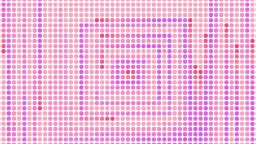
- Staircase stands the terms side by side in zigzag bands, Rows writes them one after another with line wrapping, Bars centres each term as a bar, and Spiral winds the terms outward from the centre.
- Staircase · Rows · Bars · Spiral
Examples
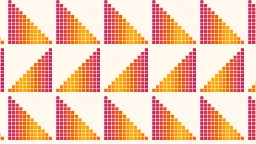
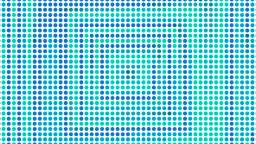
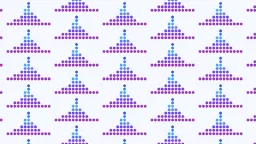
Each example opens in the studio with these settings.
Using it as a background
Each term takes the next palette colour, so the growth of the sequence becomes a gradient. A palette with a clear light-to-dark order reads best.
Dots with a large gap make a quiet texture for slides; square blocks with no gap make bold graphic bands.