Sierpiński
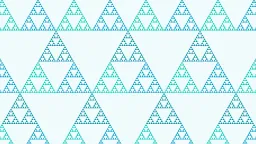
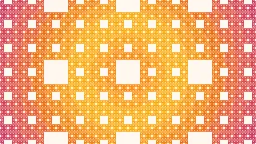
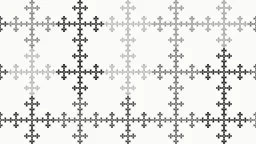
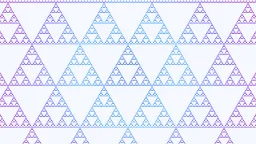
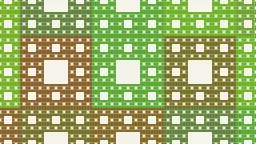
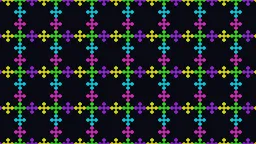
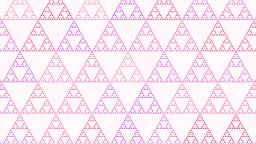
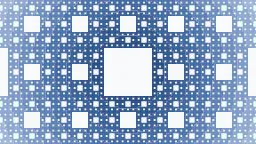
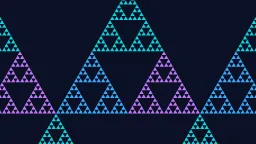
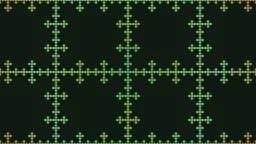
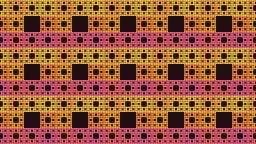
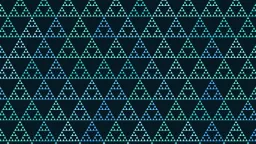
The Sierpiński triangle, carpet and cross fractals, tiled across the canvas with each level removing a fixed fraction of the shape.
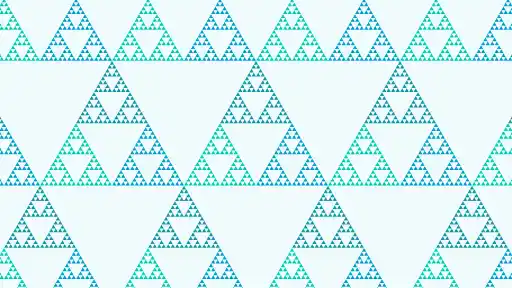
Start with a triangle and cut out the middle, leaving three smaller triangles. Cut the middle out of each of those, and keep going. Every part looks like the whole: this is a self-similar fractal.
How the maths works
- Dimension of a self-similar fractal: N pieces, each scaled by s
- D = log N / log(1 / s)
- Triangle: 3 pieces at 1/2
- D = log 3 / log 2 ≈ 1.585
- Carpet: 8 pieces at 1/3
- D = log 8 / log 3 ≈ 1.893
- Cross: 5 pieces at 1/3
- D = log 5 / log 3 ≈ 1.465
Each step replaces every piece with N copies of itself scaled by s. The triangle uses 3 copies at 1/2; the carpet uses 8 copies at 1/3, a 3 × 3 grid without the centre; the cross (the Vicsek fractal) uses 5 copies at 1/3, the centre plus up, down, left and right.
The dimension of such a fractal is D = log N / log(1 / s): about 1.585 for the triangle, 1.893 for the carpet and 1.465 for the cross. All lie between a line (1) and a filled area (2), and the less you remove, the closer it gets to 2.
After n steps the triangle has 3ⁿ pieces and (3/4)ⁿ of its original area. With infinitely many steps the area goes to 0, yet the total length of all the edges keeps growing toward infinity.
Parameters
- Fractal
- Which fractal to draw: the triangle, the carpet or the cross.
- Triangle · Carpet · Cross
- Depth
- How many steps of cutting. Each step multiplies the pieces by N; it stops by itself once they are too small to see.
- 1 to 6
- Tiles per short edge
- How many fractals across the short side; one fractal repeats to fill the canvas.
- 1 to 8
- Gap
- How much each smallest piece shrinks toward its own centre, so the levels stand apart. 0 makes the pieces touch.
- 0 to 0.3
- Colouring
- By part gives the same position (say, the bottom-left corner) the same colour; By tile gives each fractal one hue; By distance shades outward from the centre.
- By part · By tile · By distance
Examples
Each example opens in the studio with these settings.
Using it as a background
A depth of 4 to 5 looks the most fractal; beyond that the detail is too small to see. The carpet and cross make good grid-like tech backgrounds.
Add a small gap and colour by part to make the self-similarity, every part like the whole, easy to see. It is a good way to teach fractals.