Kaleidoscope
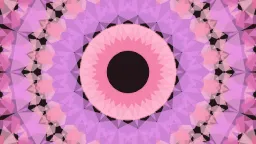
Shapes scattered in one wedge, then rotated and mirrored into N-fold rotational and reflection symmetry.
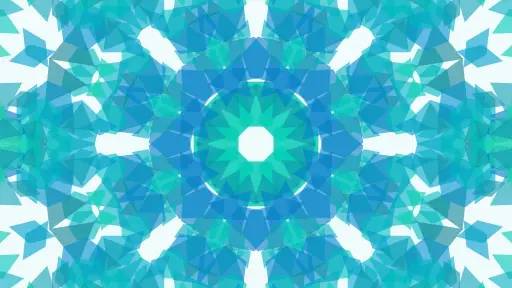
A kaleidoscope holds only a few coloured chips; two mirrors reflecting them again and again turn them into a full circle of symmetry. This pattern works the same way: shapes are scattered at random inside one wedge, then rotated and mirrored around the circle.
How the maths works
- Angle of each wedge
- θ = 360° / N
- Rotation: move the wedge to part k
- φ → φ + k · 360° / N, k = 0, 1, …, N − 1
- Mirror: the angle changes sign (a flip)
- φ → −φ
Cut the circle into N parts of 360° / N each. Turning the wedge’s contents by 0, 1, 2 … N − 1 parts gives N-fold rotational symmetry: turn the whole picture by 360° / N and it looks exactly the same.
With Mirror on, neighboring wedges are mirror images, like the two mirrors in a kaleidoscope. The pattern then has N rotations and N mirror lines, 2N moves that leave it unchanged, which mathematicians call the dihedral group Dₙ.
So every shape scattered in the wedge appears N times on the canvas (2N with Mirror). However messy the wedge is, the whole comes out orderly: that is the power of symmetry.
Parameters
- Folds
- How many parts (N). 6, 8 and 12 look like snowflakes and rose windows; more parts look like fine lace.
- 2 to 24
- Mirror
- Whether neighboring wedges mirror each other. Without it there is only rotation, and the pattern has a spin direction.
- On or off
- Shape
- Shapes scattered in the wedge: triangles, diamonds, hexagons, or a mix.
- Mixed · Triangles · Diamonds · Hexagons
- Density
- How many shapes to scatter in the wedge. More is denser.
- 40 to 600
- Shape size
- Size of each shape, measured in short edges.
- 0.02 to 0.3
- Opacity
- Opacity of the shapes. When they are translucent, overlaps mix into new colours.
- 0.2 to 1
Examples
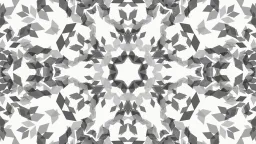
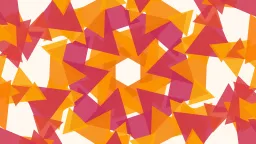
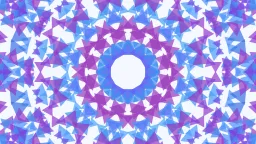
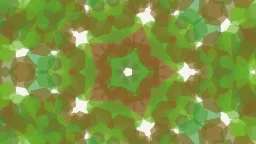
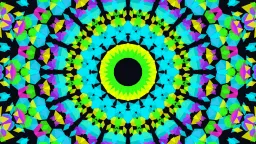
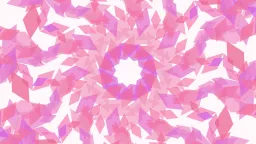
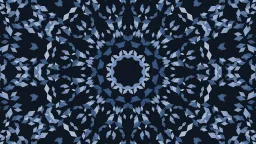
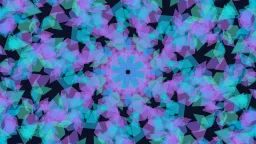
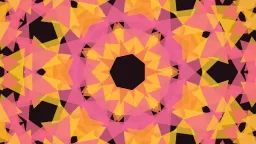
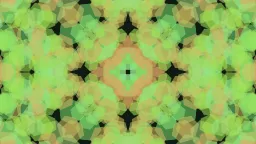
Each example opens in the studio with these settings.
Using it as a background
Symmetry 6 or 12 with Mirror on is the classic kaleidoscope; 2 or 3 looks more like an abstract print.
An opacity of 0.4 to 0.6 gives the richest overlaps; on a dark background it looks like stained glass.