Penrose Tiling
A never-repeating tiling of two rhombus shapes with five-fold symmetry, built by golden-ratio subdivision.
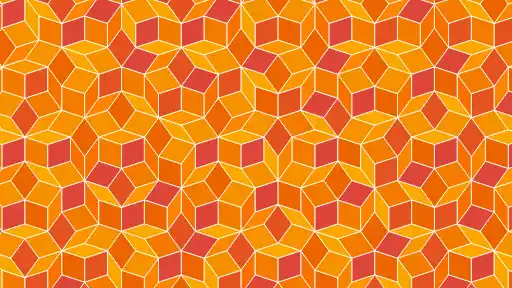
A Penrose tiling covers the plane with just two rhombus shapes and never repeats, yet looks orderly and has five-fold symmetry. Roger Penrose found it in the 1970s, and later the same kind of order turned up in real quasicrystals.
How the maths works
- The golden ratio
- φ = (1 + √5) / 2 ≈ 1.618
- Edge length after each subdivision
- ℓ → ℓ / φ
- Ratio of thick to thin rhombi
- (thick rhombi) / (thin rhombi) → φ
The two tiles are a thick rhombus with angles of 72° and 108° and a thin one with angles of 36° and 144°. Both have equal sides. Matching rules decide which edges may touch, and they force the tiling to be non-periodic: no shift of the pattern ever lines up with itself.
The editor builds the tiling by subdividing triangles. Each triangle is cut into smaller ones in the same two shapes, and every generation the edge shrinks by the golden ratio φ = (1 + √5) / 2 ≈ 1.618. Repeating this until the tiles reach the size you chose fills the canvas with a patch of the tiling.
The golden ratio shows up everywhere: the number of thick rhombi divided by the number of thin ones approaches φ, and the pentagon and pentagram that give the tiling its symmetry are full of φ. Because five-fold symmetry cannot tile a plane periodically, any large patch looks almost, but never exactly, like another patch somewhere else.
Parameters
- Tile density
- How many tiles fit along the short edge of the canvas. Tile size depends only on this, so 9:16 shows more of the same tiling instead of stretching it.
- 3 to 40
- Colour by
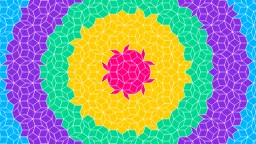
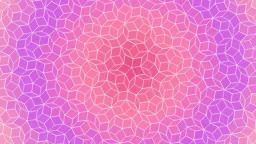
- Rhombus shape gives each of the two tile types its own colour; Orientation colours by the direction of the tile, which brings out the five-fold symmetry; Distance from centre runs the palette from the middle outward.
- Rhombus shape · Orientation · Distance from centre
- Rotation
- Turns the whole tiling, in degrees. Every 72° the pattern looks the same, so the range stops at 36°.
- 0 to 36
- Centre offset
- Moves the centre of five-fold symmetry away from the middle of the canvas. The seed picks the direction.
- 0 to 0.5
- Show edges
- Draws a thin outline in the background colour around every tile.
- On or off
- Edge width
- Width of the outline, relative to the short side of the canvas.
- 0.0005 to 0.01
Examples
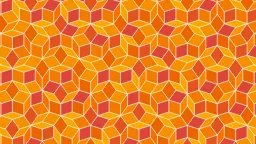
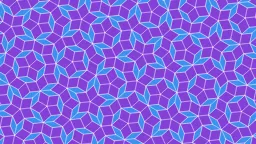
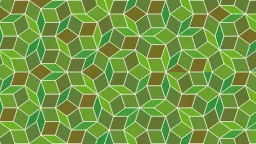
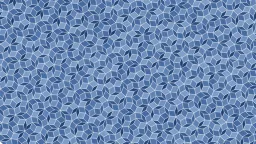
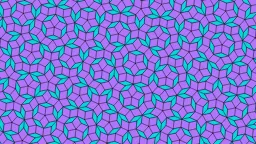
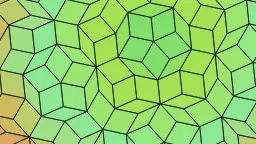
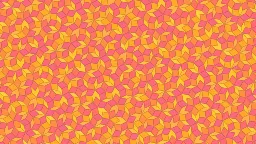
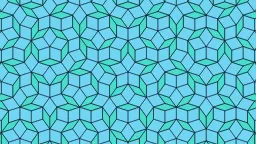
Each example opens in the studio with these settings.

Using it as a background
Orientation colouring with a soft palette gives a lively but quiet background; shape colouring with two contrasting colours makes the thick and thin tiles easy to see for a lesson on the tiling.
Moving the centre a little off the canvas centre keeps the symmetry point from sitting behind a title, and the same design re-lays out for slides, phone wallpapers and vertical video.